Crimea. General facts
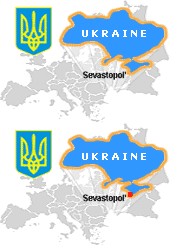
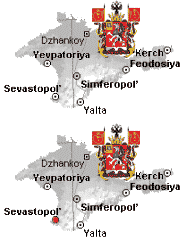
 - is a mountainous peninsula in the Black Sea, just west of the Caucasus region
of Russia and directly north of Turkey, connected with the mainland by an isthmus
of 8 km. - is a mountainous peninsula in the Black Sea, just west of the Caucasus region
of Russia and directly north of Turkey, connected with the mainland by an isthmus
of 8 km.
- is an autonomous republic within the Republic of the Ukraine and has a population of 2.8 million people who form part of more than 70 nationalities (68% Russians, 23% Ukrainians, 6% Crimean Tatars, 3% Belorussian, Armenian, Jewish, Greek, German and Karaim).
- languages: Russian, Ukrainian and Tatar. Russian is the official language used by the Government.
- extends about 320 km (200 mi) from east to west and about 175 km (110 mi) from north to south.
- has a total area of 25,993 sq km ( 10,036 sq mi), a bit smaller than that of Israel (28,251 sq km).
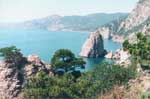 - capital: Simferopol. - capital: Simferopol.
- economy: main resources are coal, iron, manganese, oil, gypsum and alabaster and the economy is based mainly on farming, fishing, metallurgical industries and tourism.
- Crimean southern coast is famed as a resort area (often called now as the Crimean Riviera).
Some facts from Crimean History
Pre-history
Settlements of the Neanderthal Man - Central Crimea - Zuya, Belogorsk Caves of 'prehistoric' people
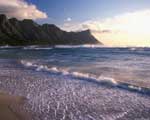 Menhirs - locations: the Baydary valley (Sevastopol district), Gogaz-Sal gorge (Bakhchisarai) Menhirs - locations: the Baydary valley (Sevastopol district), Gogaz-Sal gorge (Bakhchisarai)
Cromlech - location: Alushta
Dolmen - location: village Peredovoye (Sevastopol district)
First known people communities.
Name: Kemi-Oba people. Location: Tash-Ayr, River Kacha valley (Sevastopol district)
Time: unknown
Kimmerians - unknown ethnic identity.
Time: 15-12 century b.c.
Known for fierce raids against Asia Minor.
Absolutely exterminated by Scythians.
Scythians - an Indo-European ethnic group. Came from modern Iran and Central Asian lands in 7th century b.c.
Occupied the Crimea, Southern Russia and Ukraine as far as Kiev and the Volga.
Built their capital called Neapolis in the place of modern Simferopol. Built a strong nomadic state. Defeated a strong Persian army in 512 b.c. headed by Darius I. Raided Egypt and Asia Minor. Pharaoh paid them to prevent invasion. Traded with Greeks in Crimean towns.
Tauris - an unknown ethnic group. Known since 1125 b.c. when supposedly visited by Argonauts. Also supposedly visited by Odysseus at Balaklava. Made human sacrifices, attacked trade vessels on their small canoes. Conquered and annihilated by Romans.
Built the Temple of the Virgin (supposed location being excavated at Balaklava) where made human sacrifices. It existed from 8 to 3 century b.c. The cult of the Virgin was borrowed by Greeks who lived at Khersonesus (modern Sevastopol).
Greeks. Came from the polis of Miletes and built the city of Panticapeum (Eastern Crimea - modern Kerch). It later became the capital of the strong Bosphorian Kingdom. Settlers from Geracleum (southern shore of the Black Sea - modern Turkey) founded the city of Khersonesus (on territory of modern Sevastopol) in 422 b.c. which existed until 1472 a.d. when was ruined by Mongols. Traded and fought with Scythians. Greeks founded several trade cities on the Crimean shore which flourished. Feodosia (south-eastern Crimea) is among them. Preserved its name for more than two thousand years.
Sarmatians - another Indo-European group, relatives of Scythians (supposedly ancestors of modern Ossessians - the only Christian nation of the Northern Caucasus) invaded Crimea in 4 b.c. Subdued Scythians and strengthened their decaying kingdom.
Greeks asked for Roman help to fight off hostile inhabitants of Crimea. Roman fleet of 40 battleships came to Khersonesus with a garrison to help guard the city. Romans built several fortresses in Crimea by 63 a.d. Pieces of old Roman roads still can be found in mountains around Sevastopol.
Apostle Andrew came to Panticapeum in Eastern Crimea and then to Khersonesus and preached the Gospel in about 60 b.c. (supposedly). Bishop Clement of Rome was exiled to quarries in Kheronesus and then killed in 94 a.d.
Goths invaded the peninsula in 3 a.d. Mixed with Scythians.
Hunns headed by Atilla on their way from Central Asia invaded Crimea in 4 a.d. Goths retreated to the mountains and foothills of the peninsula.
The Byzantines came in 395 a.d. A chain of fortresses (11) was built.
Turkic tribes from the Altai mountains (Southern Siberia) began to settle in Crimea in 6th century a.d. Some of the tribe names: Khazars, Bulgars (gave name to modern Bulgaria).
Russians raided the peninsula since 800 a.d. Prince Bravlin captured Sudak (south-eastern Crimea).
Cyril and Methodius (two Bulgarian monks who translated the Gospel into Old Slavonic) came to Khersonesus.
Petchenegs (another Turkic tribe) came in 900 a.d.
Prince Vladimir was baptized in Khersonesus in 988 a.d. and shortly afterwards brought Christianity to Kievan Russia. Russian principality called Tmutarakan' was founded in Eastern Crimea (modern Kerch district) in 1000 a.d.
12th century. Italians from cities of Venice and Genoa founded trade towns in Balaklava (Chembalo), Sudak and Feodosia. Surrounding territories fell under their rule.
1223 a.d. - an army of Mongols invaded Crimea. 13th century - Crimea fell under the Mongol rule. Ancestors of modern Crimean Tatars came.
1472 a.d. - destruction of Khersonesus by Mongol-Tatars.
Two khanates existed in Crimea until 1443 when they merged into one with the capital in Chufut-Kale (Jewish Fortress) near Bakhchisarai.
Three states existed in Crimea in 14th century: Feodoro - a Christian state, successor of the Greek-Byzantine empire. It was located in the mountains around Sevastopol. The Tatar Khanate - almost all territory of Crimea. Italian lands - coastal strips near Balaklava and along the southern shore of the peninsula.
Turks conquered the land in 1454 a.d. Subdued the Tatars, destroyed Feodoro and Italian states.
In 1478 Tatars received autonomy from the Turks and remained their vassals until annexation of Crimea by Russia in app. 1774.
At certain periods of history, various national groups settled in the peninsula. Greeks and Bulgarians sought refuge in the Crimea (at that time - a part of Russian lands to escape Turkish oppression.
Khazars, one of the Turkic tribes, brought here Judaism that has stayed with several national groups until now. Those groups mixed with Jewish refuges and are represented by two small nations: Karaites and Krymchaks that profess Judaism. They build their synagogues called "kenassas". The center of the Jewish religious life was Chufut-Kale (The Jewish Fortress - in Turkic) - a cave city near Bakhchisarai that was later captured by Tatars.
Many Armenians came to live in Crimea in different ages. At a certain time in the Middle Age the city of Feodosia had up to 60-70 percent of Armenian population. The settlers built their churches of which some have remained in Yalta, Feodosia and Eupatoria.
The city of Sevastopol was founded in 1783 as a Russian naval fortress to protect its southern borders. It was built in place of the Ancient Greeks' city of Khersonesus.
Some other facts
The Crimean war - allied forces of England, France, Turkey and the Kingdom of Sardinia attacked Sevastopol. The war lasted for one year: 1854-1855 and brought little glory to all participants. The city was razed.
World War II (The Great Patriotic War in Russian) brought tremendous human losses with the city being razed for the second time and Germans capturing it in 1942 and then leaving it in 1944. The heroic defense of Sevastopol by the Russians helped to halt the German offensive on Moscow in 1941.
May 9, 1944, the whole population of Greeks, Bulgarians and Crimean Tatars was deported from the peninsula for 'collaboration' with Germans. Pres. Gorbachev officially banned restrictions allowing them to return at the end of the 80s.
1957. Pres. Khrushchev gave the Crimea to the Ukraine in order " to further the brotherly union between the two Soviet republics". It had always been a part of Russia before.
|
![[home]](images/up01.gif)